

Register for the AI4J Leadership Summit
99 Days
:
08 Hours
:
56 Minutes
:
05 Seconds
core-swoosh 1

100% OpenJDK Migration Success 

Oracle Java Migration and Compliance

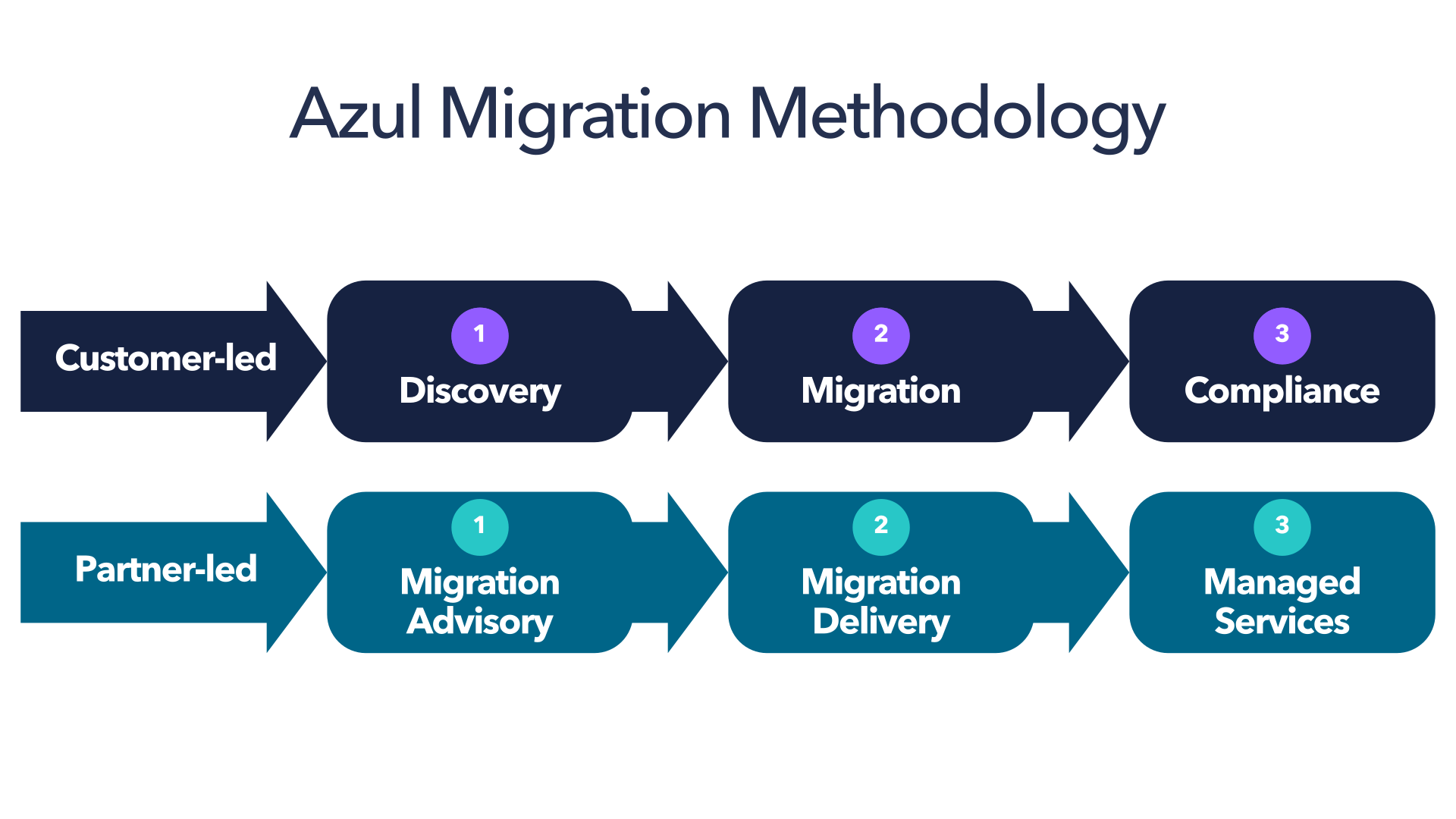
88% of companies are considering migrating from Oracle Java to an OpenJDK vendor due to Oracle’s evolving Java licensing model but are confronted by complexity and risk. Azul is the only OpenJDK provider that can derisk the complexity of migration via our proven methodology that has a track record of 100% success across hundreds of enterprises.

Migration Images Presentation

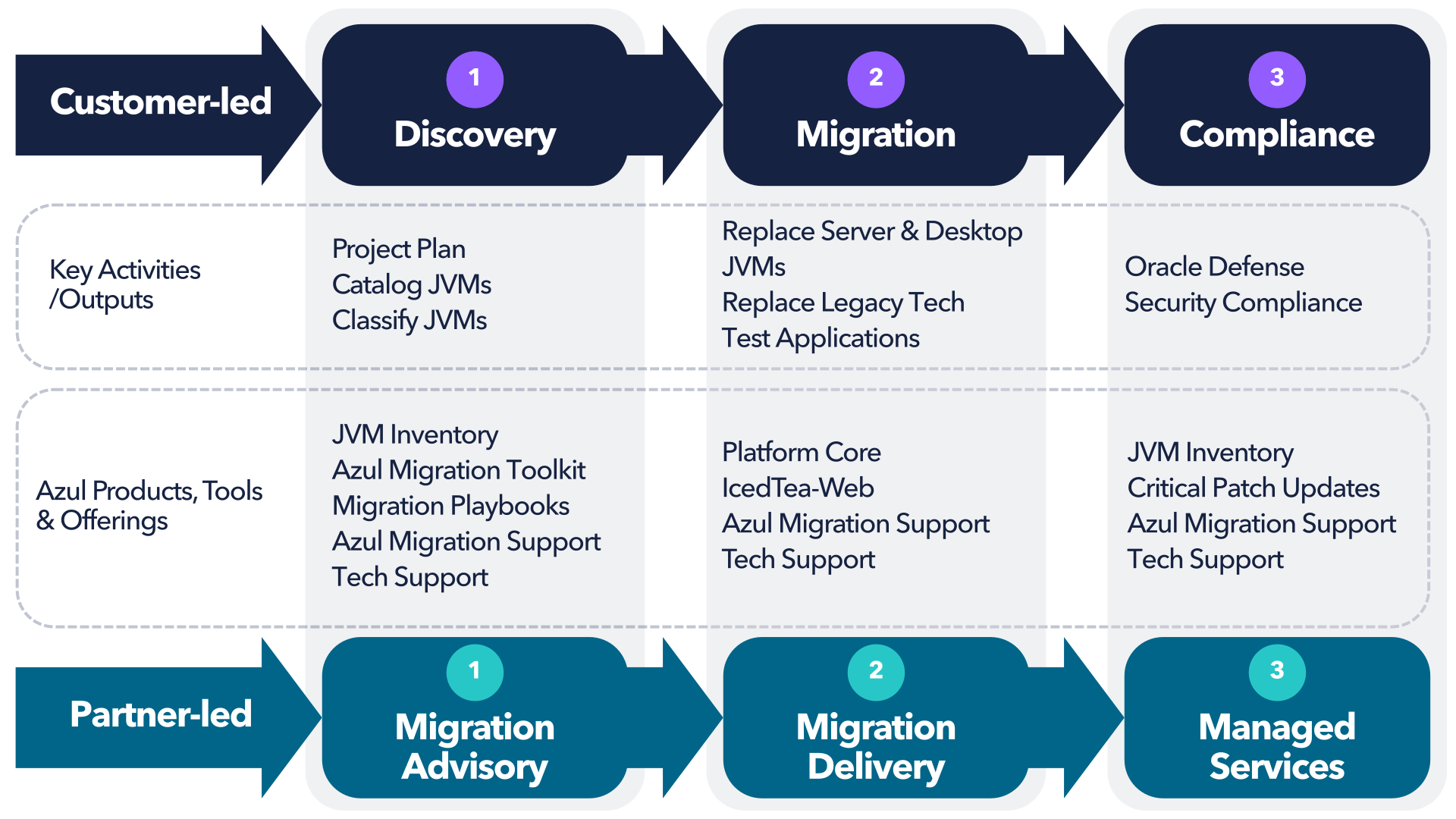
Discovery

You can’t start until you know what you’ve got.

push_pin

Project Plan

Create a project plan based on your product release plans/policies and leveraging Azul’s migration playbooks which include step-by-step Oracle JDK to OpenJDK migration instructions that can be automated.


policy

Catalog JVMs

Create a catalog of all installed JVMs using Azul Migration Toolkit (AMT), or ITAM tools like Flexera, SNOW, etc., to generate a static snapshot of all deployed instances, complimented by Azul JVM Inventory’s continuous runtime detection to help identify which JVMs are not being used, which are in use and what applications they’re running.

computer

Classify JVMs

Dramatically reduce the time to classify JVMs as to vendor, version, application owner, license liability (if any), etc., using JVM Inventory, and then automate the creation of a prioritized list of JVMs for replacement.

Migration

Accelerate migration and derisk legacy technology replacement.

radar

Replace Server & Desktop JVMs

Using the identified application owners in the Discovery step and Azul’s migration playbooks, enterprises can automate server-side and desktop replacement of all Oracle JVMs with Azul Core so migration is completed quickly and easily before Oracle renewal.

policy

Replace Legacy Technology

Unlike other OpenJDK vendors, Azul provides commercially supported, open source solutions for Java Web Start (based on IcedTea-Web) and applet alternative solutions for Java Applets ensuring that every instance of Oracle that carries a license liability can be eliminated from the organization.

support

Test All Applications 

Leverage Azul’s best practices and extensive knowledgebase to significantly reduce the level of effort needed to validate successful OpenJDK migration.

Compliance

Ensure Java licensing and security compliance.

lock

Oracle Defense

Ensure ongoing Oracle license compliance post-migration using JVM Inventory’s continuous runtime detection capabilities to help alert when a new Oracle instance is deployed so it can be removed in a timely manner.

verified_user

Security Compliance 

Ensure regulatory security compliance via quarterly Critical Patch Update (CPU) deployments to address known vulnerabilities, as well as out-of-cycle patches to address zero-day vulnerabilities, customer-specific issues, and so on.

support

Test All Applications 

Leverage Azul’s best practices and extensive knowledgebase to significantly reduce the level of effort needed to validate successful migration.

migration-full

The Azul OpenJDK Migration Advantage

Best-in-class tools and a 100% successful migration methodology ensure customers can migrate from Oracle Java to Azul’s OpenJDK solution with confidence, even if their Java estate includes older versions of Java and legacy desktop technologies.

code

Catalog JVMs in weeks, not months

Create a detailed catalog of all JVMs across the extended enterprise in weeks, not months using runtime intelligence not available with other tools.

cloud_upload

Automate and accelerate migration

Automate server and desktop replacement of Oracle JVMs using Azul’s migration playbooks.

policy

Eliminate every instance of Oracle Java

Proven solutions for legacy technologies like Java Applets and Java Web Start mean every instance of Oracle that carries a license liability can be eliminated from the organization.

warning_amber

Ensure ongoing compliance

Instantly detect reintroduction of Oracle Java, and maintain an accurate, auditable history to defend against future audits with a verifiable runtime history.

Industry Leading OpenJDK Migration Support

Azul Migration Support 

The Azul Migration Support Team provides partner training and customer help based on Azul’s proven migration methodology, our extensive knowledge base and key products, tools and services.

Azul Global Technical Support

Azul’s technical support team is deployed on four continents to ensure timely response to any issues that may arise during migration based on an average industry experience of 20+ years per support engineer. Learn more

Azul PartnerConnect Program  

Azul’s global network of trained and certified partners provides a complete set of migration services, relieving the burden from busy internal teams. For more information, contact a partner in your geography.

bg-purple

Speak to a Migration Expert

Trust your OpenJDK migration to the only company with a 100% migration success rate.

OpenJDK Migration Frequently Asked Questions

Why are enterprises migrating from Oracle Java to OpenJDK? 

Enterprises are migrating because Oracle changed to a per-employee pricing model in January 2023 that disconnects license cost from actual Java usage. A 100-person company with two quad-core servers and 100 Java desktops typically sees a 328% price increase. A 25,000-employee company with minimal Java deployments can face bills exceeding $2 million per year. The 2026 State of Java survey found that 81% of companies have migrated, are migrating, or plan to migrate from Oracle Java to an open-source alternative.

How difficult is migrating from Oracle JDK to OpenJDK?

For server applications, migration is straightforward: install the new OpenJDK distribution, update JAVA_HOME, and restart your application. 99% of server applications work correctly on the first attempt. Edge cases are almost exclusively limited to legacy desktop technologies — Java applets, Java Web Start, and JavaFX on JDK 8 or earlier. Azul has completed hundreds of enterprise migrations with a 100% success record.

What is the difference between Oracle JDK and OpenJDK?

From JDK 11 onward, Oracle JDK and OpenJDK are built from identical source code. Both derive from the OpenJDK open-source project. The differences are in licensing terms, commercial support offerings, update schedules, and a small number of optional bundled components that existed prior to JDK 11 (JavaFX, Java Web Start, the Java plug-in). For server-side applications on JDK 11 or later, there is no functional difference.

Will I need to recompile my application when switching OpenJDK distributions? 

No. Java’s “write once, run anywhere” guarantee means the same bytecodes will execute identically on any TCK-certified JVM of the same Java version. No recompilation is needed when switching distributions. Even when moving to a newer Java version, recompilation is rarely required due to Java’s strong backward compatibility.

What is TCK certification and why does it matter?

The Java Technology Compatibility Kit (TCK) is a suite of nearly 150,000 tests that verify a Java distribution correctly implements the Java SE specification. TCK certification is the technical guarantee that two distributions of the same Java version are functionally interchangeable. Always choose a TCK-certified distribution. Non-certified distributions cannot claim Java SE compatibility and do not carry the IP protections of the Java specification.

What happened to Oracle Java licensing in 2023?

On 23 January 2023, Oracle replaced its processor-count and named-user pricing with a per-employee model under the Oracle Java SE Universal Subscription. Unlike typical per-employee SaaS pricing, Oracle’s model is disconnected from actual Java usage. Every employee at the organization counts toward the license cost, regardless of whether they use Java. This caused price increases of 300–400% for most organizations and triggered widespread migration to OpenJDK alternatives.

What are Critical Patch Updates (CPUs) and why do they matter? 

A Critical Patch Update (CPU) is a stabilized, security-only JDK update containing only security patches, not bug fixes or enhancements. A Patch Set Update (PSU) contains everything. Since the end of free Oracle JDK 8 updates, there has been at least a 25% chance per quarter that a PSU introduces a regression. CPUs allow organizations to apply security patches without this regression risk. Only Oracle and Azul provide CPU format updates for OpenJDK.

Which OpenJDK distribution should I choose?

Key factors: (1) TCK certification for all binaries; (2) support for your Java versions — only Azul supports JDK 6 and JDK 7; (3) availability of both CPU and PSU format updates — only Oracle and Azul provide CPUs; (4) update speed — leading providers release binaries within one hour of the embargo lifting; (5) platform coverage for your OS and CPU architectures; (6) GPL contamination indemnification if required.

Does Azul Core support Java 6 and Java 7?

Yes. Azul is the only OpenJDK provider that still offers commercially supported builds of JDK 6 and JDK 7, including backported security patches. Oracle stopped extended support for JDK 6 in October 2018 and for JDK 7 in July 2022. For organizations that cannot yet migrate these versions, Azul Core provides security-patched builds with full commercial support.

What is GPL contamination and how does it affect OpenJDK users? 

OpenJDK is licensed under GPLv2 with a Classpath Exception (CPE). The CPE prevents the GPL’s copyleft provisions from applying to applications that use the JDK. However, if any file in a distribution that requires the CPE is missing it, and your application makes direct API calls to that file, your application code could be subject to GPL obligations — requiring you to release your source code. Some commercial providers scan their distributions for this risk and provide contractual indemnification against it.